Planning
Glamping in Japan Without a Car: Yes, It's Possible (Here's How)
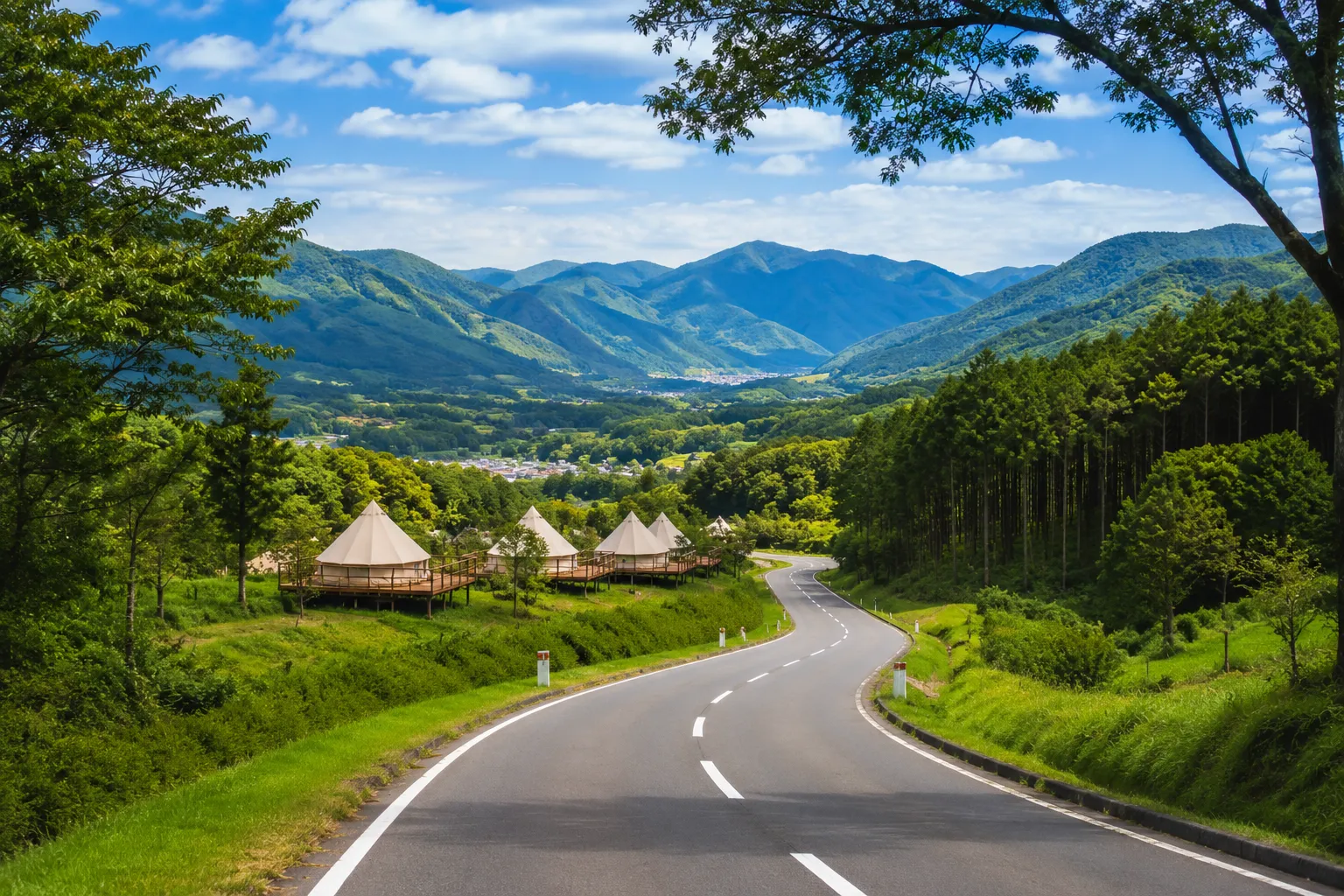
This article contains affiliate links. If you book through them, I may earn a small commission at no extra cost to you. Learn more
Every guide to glamping in Japan says the same thing: "renting a car is strongly recommended."
I've written that line myself. And it's true — a car gives you the most freedom. But it leaves out something important: most international travelers can't easily rent one in Japan. You need an International Driving Permit issued under the right convention, the confidence to drive on the left, and comfort with narrow mountain roads at night.
Here's the part nobody tells you: at the resort where I work, a large share of our guests arrive without a car. Trains, highway buses, and resort shuttles get them here just fine. This guide is how they do it.
The Three-Step Formula
Almost every car-free glamping trip in Japan follows the same shape:
Step 2 is the one that trips people up, and it's the one you must confirm before you book. More on that below.
Option 1: Highway Bus (The Easiest)
If you only remember one thing from this article, make it this: the highway bus is the best car-free option for the Mount Fuji area.
Direct buses run from Shinjuku Station to Kawaguchiko Station in roughly 2 hours, with no transfers, for around ¥2,000–2,500 each way. You sit down in central Tokyo and get off at the gateway to the Fuji Five Lakes.
Why it beats the train here:
What to know:
Option 2: Train
Trains shine when your destination is coastal Chiba or anywhere on a JR line.
To Chiba (Boso Peninsula): JR lines from Tokyo Station run down both coasts. Expect 1.5–2 hours to the main glamping areas. If you have a Japan Rail Pass, this is effectively free.
To Kawaguchiko: JR to Otsuki, then transfer to the Fujikyu Railway. Around 2–2.5 hours total. Slower and pricier than the bus, but covered in part by the JR Pass, and the Fujikyu leg has lovely mountain views.
What to know:
Option 3: Resort Shuttle (The Missing Piece)
This is the option most travelers don't know exists, and it's the one that makes car-free glamping actually work.
Many Japanese glamping resorts run free shuttles from the nearest station for guests. For example, Suite Glamping Fujikawaguchiko picks up guests at Kawaguchiko Station or the Fuji-Q Highland bus terminal, running late afternoon for check-in and morning for check-out — with advance reservation required, usually by phone the day before.
That last detail matters enormously:
What to do: After booking your room, email or call the resort and confirm the shuttle. A simple message works: "I will arrive at [station] at [time] on [date]. Is the shuttle available? Two people." Most resorts that serve international guests will reply in English.
Option 4: Taxi for the Last Mile
If there's no shuttle, a taxi from the nearest station is usually short — most glamping resorts sit 10–25 minutes from a station, which typically runs ¥2,000–5,000.
Two warnings from experience:
Which Destinations Work Best Without a Car?
| Destination | Car-free difficulty | Best route |
|---|---|---|
| Lake Kawaguchiko | Easy | Highway bus from Shinjuku + resort shuttle |
| Lake Yamanakako | Easy–Moderate | Highway bus + shuttle or short taxi |
| Coastal Chiba | Moderate | JR train + taxi from station |
| Gotemba / Shizuoka side | Moderate | Bus or train + taxi |
| Asagiri Highlands | Hard | Sparse buses — car strongly preferred |
| Rural Ibaraki | Hard | Limited services — check case by case |
If it's your first car-free glamping trip in Japan, start with Kawaguchiko. The infrastructure there is built for visitors without cars.
Four Rules for a Smooth Car-Free Trip
1. Confirm the last mile before you book the room.
The resort's website may say "15 minutes from the station" without mentioning that no bus covers that distance. Ask first, book second.
2. Pack light — or send your luggage ahead.
Japan's takkyubin luggage delivery service will forward suitcases from your Tokyo hotel to your resort (often ¥2,000–3,000 per bag, arriving next day). You travel with a small overnight bag. Most hotel front desks arrange this for you, and it transforms the trip.
3. Plan around the last bus, not the sunset.
Rural transport thins out dramatically after dark. Build your day around the return timetable and you'll never be stranded.
4. Choose resorts with on-site everything.
This is where glamping is genuinely ideal for car-free travel: meals, activities, and gear are all included on the property. Once you arrive, you don't need transport at all. See my cost guide for what's typically bundled in.
A Sample Car-Free Weekend
Here's the itinerary I'd give a friend visiting from abroad:
Saturday
Sunday
No car, no licence, no stress.
How to Book
For accommodation, Booking.com is the easiest place to compare Japanese glamping resorts in English — and the listings usually specify the nearest station, which is exactly what you need for planning the last mile. Search "glamping Kawaguchiko" or "glamping Chiba" to see what's available on your dates.
For activities and day tours, GetYourGuide is useful for a different reason: many Fuji-area tours include hotel pickup from central Tokyo, which removes the transport problem entirely for a day trip.
The Bottom Line
You do not need a car to experience glamping in Japan. You need one phone call about a shuttle, a reserved bus seat, and a bit of timetable awareness.
Start with Kawaguchiko, confirm the shuttle when you book, and travel light. Once you're sitting by the fire with Mount Fuji in front of you, nobody will ask how you got there.
Ready to explore Japan's outdoors?
Book your stay and your activities with English-language support, international payments, and flexible cancellation.