Glamping
6 Best Glamping Resorts in Japan, Named and Honestly Compared
This article contains affiliate links. If you book through them, I may earn a small commission at no extra cost to you. Learn more
Most "best glamping in Japan" articles never name a single place. This one does.
I work at a glamping resort in Japan, so I see this industry from the inside — what guests rave about, what they complain about, and which places deliver what they promise. Below are six resorts I'd genuinely point a friend to, depending on their budget and travel style.
One honest note up front: one of these six is the resort where I work. I've marked it clearly so you can weigh my bias for yourself.
Quick Comparison
| Resort | Area | Style | Price feel |
|---|---|---|---|
| HOSHINOYA Fuji | Lake Kawaguchiko | Luxury cabins, Fuji view | ¥¥¥¥ |
| Dot Glamping Fujiyama | Lake Kawaguchiko | Domes with Fuji view | ¥¥¥ |
| PICA Fujiyama | Fujiyoshida | Activity-focused village | ¥¥ |
| Fujino Kirameki | Gotemba (Shizuoka) | Cabins & domes, Fuji view | ¥¥¥ |
| Private Villa Glamping Fuji Yamanakako | Lake Yamanakako | Private onsen & pool villas | ¥¥¥¥ |
| BUB RESORT | Chosei, Chiba | All-inclusive activity resort | ¥¥¥ |
Prices move a lot by season and day of the week — treat the ¥ marks as relative, and check current rates before you plan. My cost guide explains what's normally included.
1. HOSHINOYA Fuji — the luxury benchmark
Lake Kawaguchiko, Yamanashi · ¥50,000–¥80,000+ per person
Japan's first luxury glamping resort, opened by the Hoshino Resorts group, and still the name everyone in this industry measures themselves against.
What it's actually like: The cabins are minimalist concrete cubes built into a hillside above Lake Kawaguchi, each with a full glass wall and a private balcony facing the water. It reads more like architecture than camping — deliberately so. Staff are called "Glamping Masters," and their job is to remove every friction point: they light your fire, prepare your meals, and run activities like canoeing and morning horse riding.
The thing that makes it different: The forest dining. Meals are cooked over a wood fire at an outdoor kitchen in the trees, and eaten under the sky. Almost no other resort in Japan does this at this level.
Why I'd pick it: You want the single most polished glamping experience in Japan, and budget isn't the constraint. It's the one I'd choose for an anniversary or a once-in-a-decade trip.
Keep in mind: This is hotel-level pricing, and the cabin design — concrete, minimal, open — is more "architectural retreat" than "cosy tent." Some guests love that; some expect something warmer. It's also popular with international travellers, so autumn weekends book out months ahead.
Best for: Honeymoons, milestone trips, design-minded travellers, first-class Fuji views.
2. Dot Glamping Fujiyama — the Fuji-view dome sweet spot
Lake Kawaguchiko (Oishi area), Yamanashi · ¥25,000–¥45,000 per person
This is the one I recommend most often, because it delivers the picture people actually came to Japan for at a price that isn't absurd.
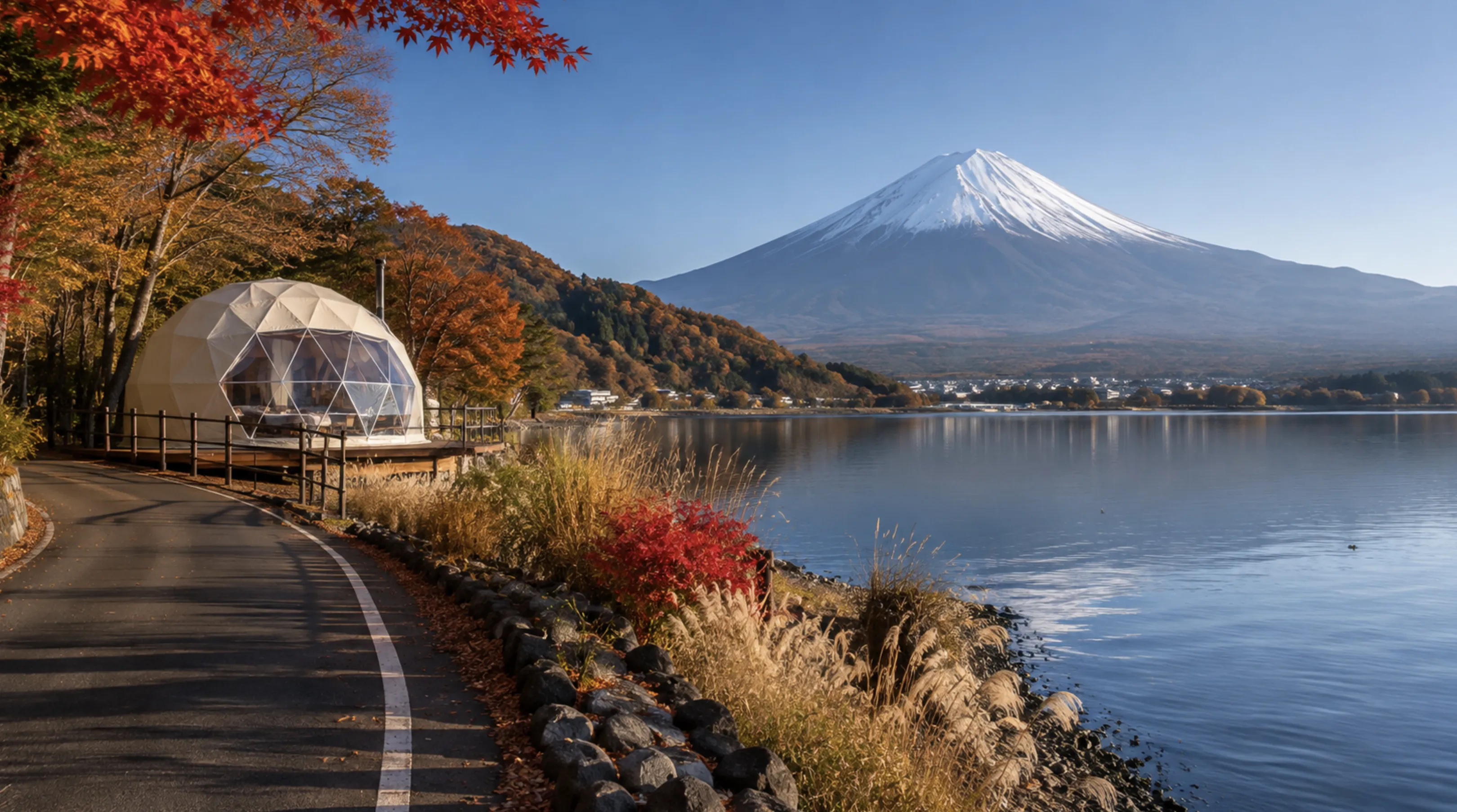
What it's actually like: Geodesic dome tents on the northern shore, in the Oishi area — the quieter side of Kawaguchiko, away from the main tourist strip. Each dome has a large curved window aimed directly at the mountain. You lie in bed, open your eyes, and Fuji is framed for you. That's the entire product, and it works.
The thing that makes it different: Location. Oishi Park, a short walk away, is one of the most photographed spots on the lake — lavender in summer, kochia turning red in autumn, with Fuji behind. You get the postcard view from your bed and on a five-minute walk.
Why I'd pick it: The classic "wake up to Fuji" experience without HOSHINOYA pricing. For a first glamping trip in Japan, this is my default answer.
Keep in mind: Fuji hides behind cloud often, especially summer afternoons. Book two nights so you get two mornings — the difference between a great trip and a disappointed one is often just one extra sunrise. My season guide explains when visibility is best.
Best for: Couples, photographers, first-timers chasing the dome-with-Fuji shot.
3. PICA Fujiyama — the activity base camp
Fujiyoshida, Yamanashi
Part of the PICA group that runs outdoor resorts across the Fuji area. Less "romantic bubble," more "well-run outdoor village": cottages, domes and tents, with paragliding, kayaking, and craft classes on the menu, and easy access toward Mount Fuji's 5th station.
The thing that makes it different: Proximity to Mount Fuji itself. It's about half an hour from the 5th Station, which makes it a genuine base camp if climbing Fuji is on your itinerary — you can sleep properly the night before rather than at a mountain hut.
Why I'd pick it: You want a full outdoor weekend — climbing, paragliding, kayaking, craft workshops — with comfortable beds between adventures. It's also one of the better-value Fuji-area options.
Keep in mind: This is a lively, family-friendly outdoor village rather than a silent hideaway. Accommodation ranges from simple tents to full cottages, so read the room type carefully — the cheapest options are noticeably more basic than the domes elsewhere on this list.
Best for: Active travellers, families with older kids, anyone climbing Fuji.
4. Fujino Kirameki Fuji Gotemba — the Shizuoka-side view
Gotemba, Shizuoka
On the southern (Shizuoka) side of Fuji, with cabins and dome tents facing the mountain, plus day activities like cave exploration in the Aokigahara forest area, horse riding and fishing. Gotemba is also home to Japan's biggest premium outlet mall, which pairs oddly well with a glamping trip.
The thing that makes it different: The angle. Almost every Fuji glamping photo you've seen is taken from the north (Kawaguchiko). From Gotemba you see the southern face, with a broader, less symmetrical profile — and far fewer international visitors around you.
Why I'd pick it: You're routing through Hakone or Shizuoka rather than Shinjuku, or you've already done Kawaguchiko and want the other side. Gotemba Premium Outlets is also nearby, which pairs surprisingly well with a nature stay for anyone travelling with a shopping list.
Keep in mind: Access is easier from the Hakone/Odawara direction than from central Tokyo. Check your route before assuming it's interchangeable with Kawaguchiko.
Best for: Hakone-combination itineraries, repeat visitors, shoppers.
5. Private Villa Glamping Fuji Yamanakako — the private-everything option
Lake Yamanakako, Yamanashi
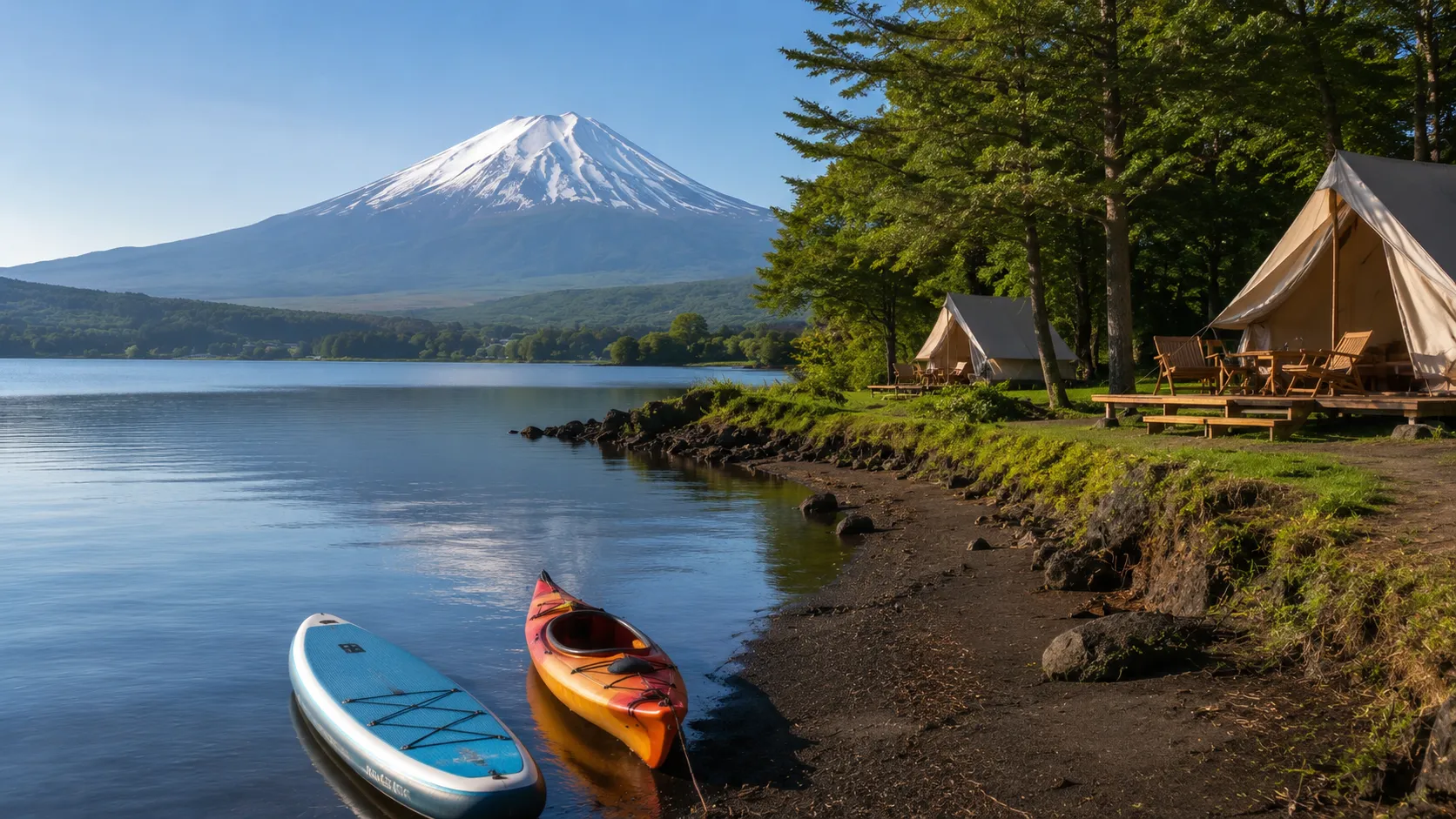
A newer breed of Japanese glamping: fully private villas with in-room hot springs, private pools, barrel saunas and campfires, near the largest of the Fuji Five Lakes. SUP and canoeing are right there on the lake.
The thing that makes it different: You never share anything. No communal bathhouse, no shared BBQ area, no walking past other guests to reach a facility. For travellers who are uneasy about Japanese communal bathing — a real barrier for many international visitors — this removes the issue entirely: the onsen is inside your villa.
Why I'd pick it: Privacy is the priority, or you're travelling as a small group who want the place to yourselves. It's also the most comfortable option on this list for a winter stay, since your bath and sauna are steps from the bed.
Keep in mind: Private onsen, private pool and sauna put this at the premium end, comparable to HOSHINOYA. Lake Yamanakako is also the highest and coldest of the Fuji Five Lakes — excellent in summer, genuinely cold in winter.
Best for: Anniversaries, small groups, anyone who'd rather skip communal bathing.
6. BUB RESORT — the all-inclusive activity marathon (where I work)
Chosei Village, Chiba
Full disclosure: this is the resort where I work. Judge my bias accordingly — but it also means I can tell you exactly what happens here, every day.
BUB is a different concept from the view-focused Fuji resorts: it's an all-inclusive "experience theme park" about 60–90 minutes from Tokyo, where a full schedule of activities runs from morning to night — archery, axe throwing, kayaking, craft workshops, fire-making, seasonal festivals — all led by resident staff (many of whom speak English). Meals and activities are bundled in, so you never touch your wallet after check-in.
What a day actually looks like: Activities run on a printed schedule from morning until after dark, and you pick what you want. On a typical day that might include axe throwing, archery, kayaking, a craft workshop, mochi pounding, a night nature walk, and a bonfire — with seasonal additions like festivals in summer and Halloween events in autumn. Meals and activities are bundled into the rate, so after check-in you don't take your wallet out again.
The thing that makes it different: The staff. Activities are led in person rather than left as equipment for you to figure out, and many crew members speak English. For international guests this ends up being the memorable part — you spend a day actually interacting with Japanese people your own age, which is surprisingly rare on a standard Japan itinerary.
Why I'd pick it: You want your days full — especially with children — and you'd rather participate than just look at scenery. It's also the closest resort on this list to Tokyo, at 60–90 minutes.
Keep in mind: It's social and energetic by design. There's no Mount Fuji view here, and if what you want is silent solitude in nature, Yamanakako or Ibaraki suits you better.
Best for: Families, groups of friends, travellers who get restless sitting still. My family glamping guide covers what works at each age.
How to Choose Between Them
If you're staring at six options and can't decide, use this:
Start with the one question that actually matters: is a Mount Fuji view essential?
Then check your second constraint:
| If your priority is… | Choose |
|---|---|
| Doing as much as possible | BUB RESORT or PICA Fujiyama |
| Total privacy | Private Villa Glamping Fuji Yamanakako |
| The best possible version of this | HOSHINOYA Fuji |
| Value for a Fuji view | Dot Glamping Fujiyama |
| Shortest trip from Tokyo | BUB RESORT (60–90 min) |
| Combining with Hakone | Fujino Kirameki Fuji Gotemba |
| Travelling without a car | Dot Glamping or PICA (Kawaguchiko bus + shuttle) |
One thing I'd tell anyone booking their first Japanese glamping trip: the resort matters less than the season and the number of nights. A mid-range resort on a clear November morning beats a luxury resort in cloudy August. My season guide covers the timing, and my cost guide covers what you get at each price point.
How to Book These
Accommodation: Most of these resorts appear on Booking.com with English-language pages and flexible cancellation — search the resort name directly, or try "glamping Kawaguchiko," "glamping Yamanakako," or "glamping Chiba" to see what's available on your dates. The rest have official English sites; compare both, since direct sites sometimes include activity bundles that third-party listings miss.
Activities around your stay: For tours and experiences to pair with any of these — Fuji day trips, kayaking, cultural workshops — GetYourGuide is the easiest option for foreign visitors, with English booking and free cancellation on most tours.
Timing: Autumn weekends and Golden Week sell out months ahead at every resort on this list. My season-by-season guide covers when to book what.
The Bottom Line
Whichever you pick, you'll understand within an hour of check-in why glamping has taken over Japan's travel scene. Sleep in nature; skip the suffering.
Ready to explore Japan's outdoors?
Book your stay and your activities with English-language support, international payments, and flexible cancellation.