Glamping
This article contains affiliate links. If you book through them, I may earn a small commission at no extra cost to you. Learn more
Glamping (glamorous camping) has exploded in popularity across Japan over the last few years. Unlike traditional camping, glamping lets you sleep in stylish tents, cabins, or domes — fully equipped with beds, electricity, and often gourmet BBQ meals.
Japan's glamping scene is unique: it blends the country's love of hospitality (omotenashi) with the beauty of its natural landscapes. You'll find resorts nestled in forests, by the ocean, near Mount Fuji, and along rivers.
I work at a glamping resort in Japan, so everything in this guide comes from firsthand experience — not a travel blog written from a laptop.
If you only read one section, read this.
The word "glamping" covers several quite different structures in Japan, and which one you book changes the experience more than the region does.
| Type | What it is | Best for |
|---|---|---|
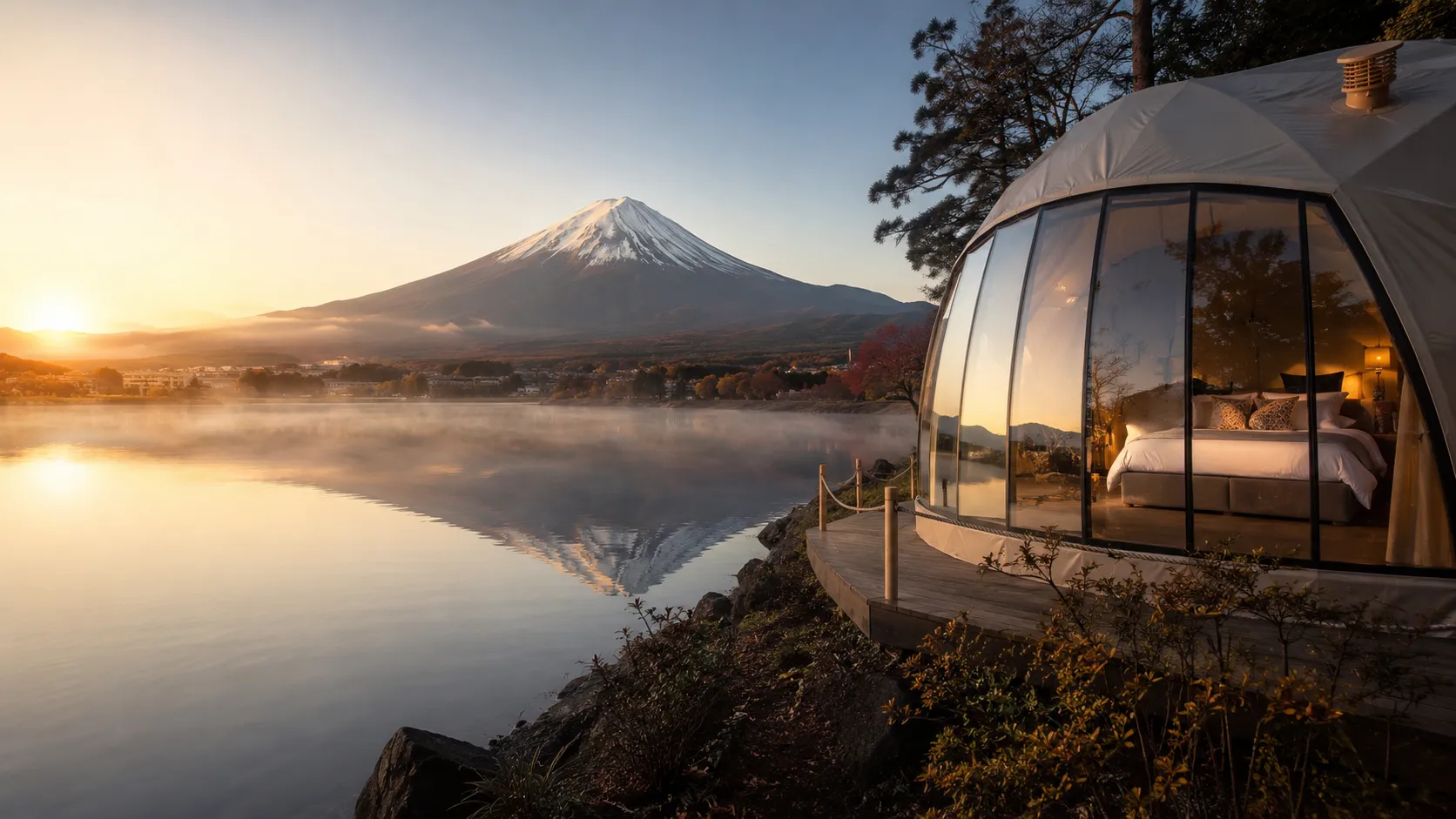
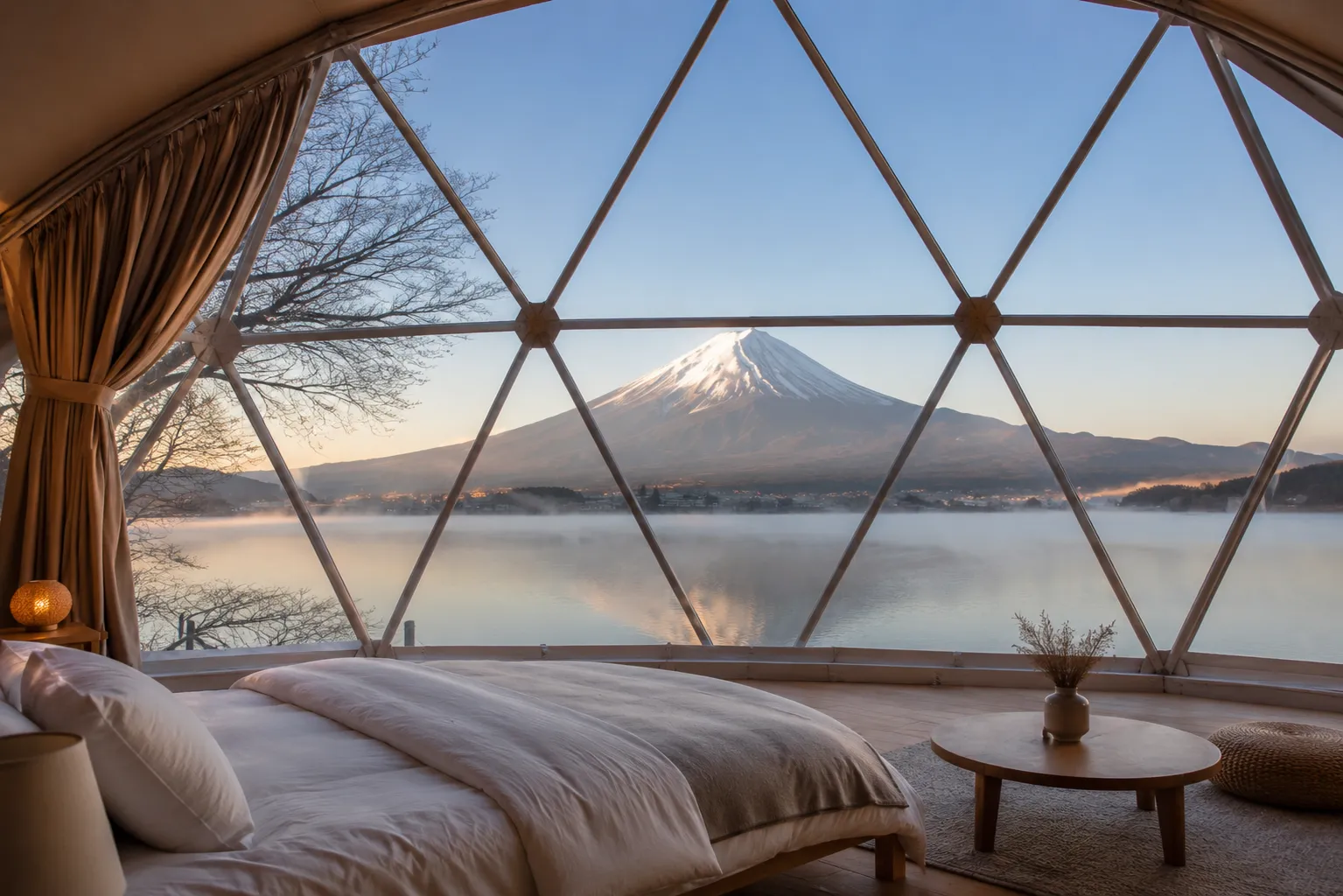
| Dome tent | Geodesic dome, often with a large transparent window | Views — the Mount Fuji shot you've seen online |
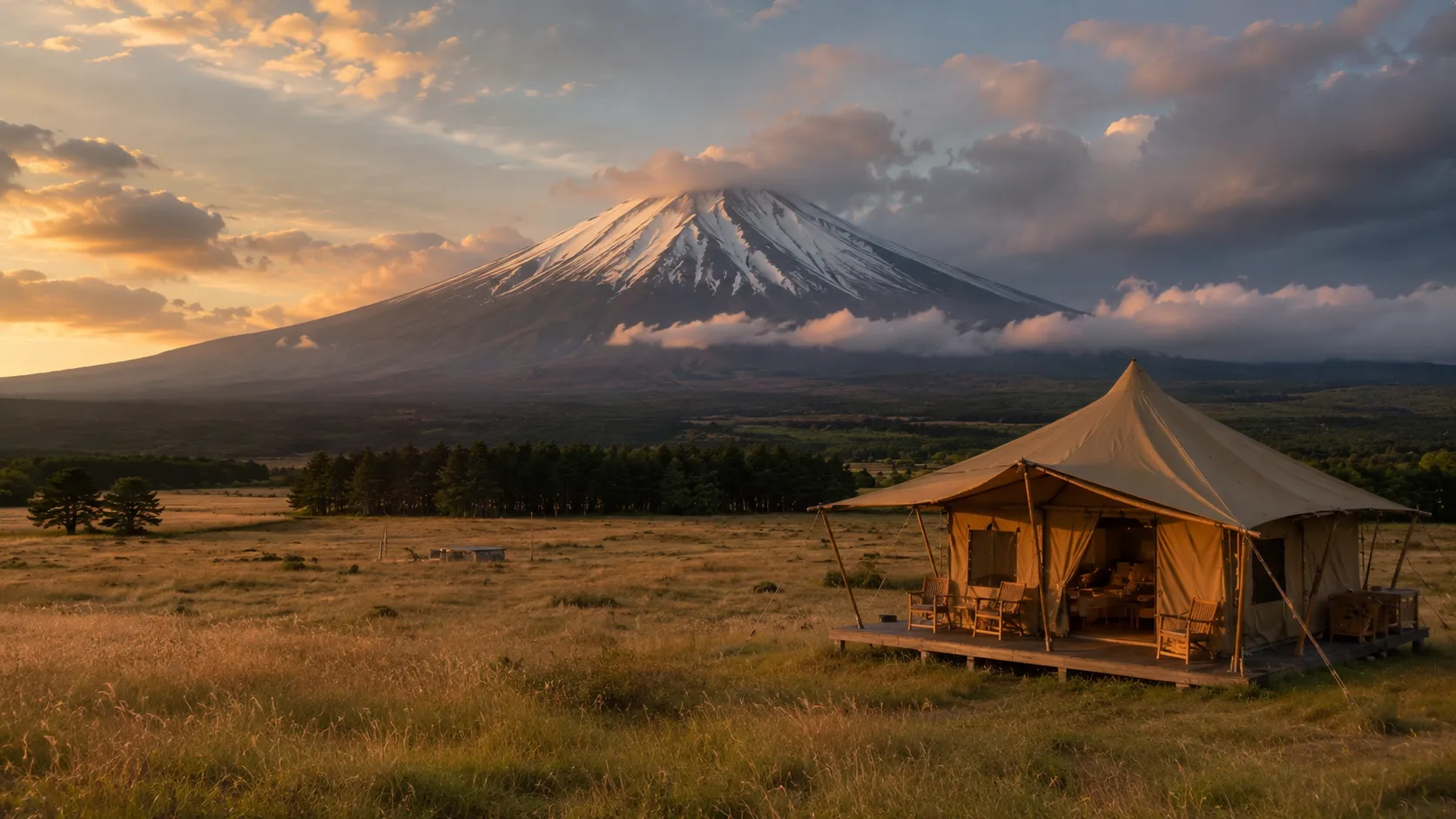
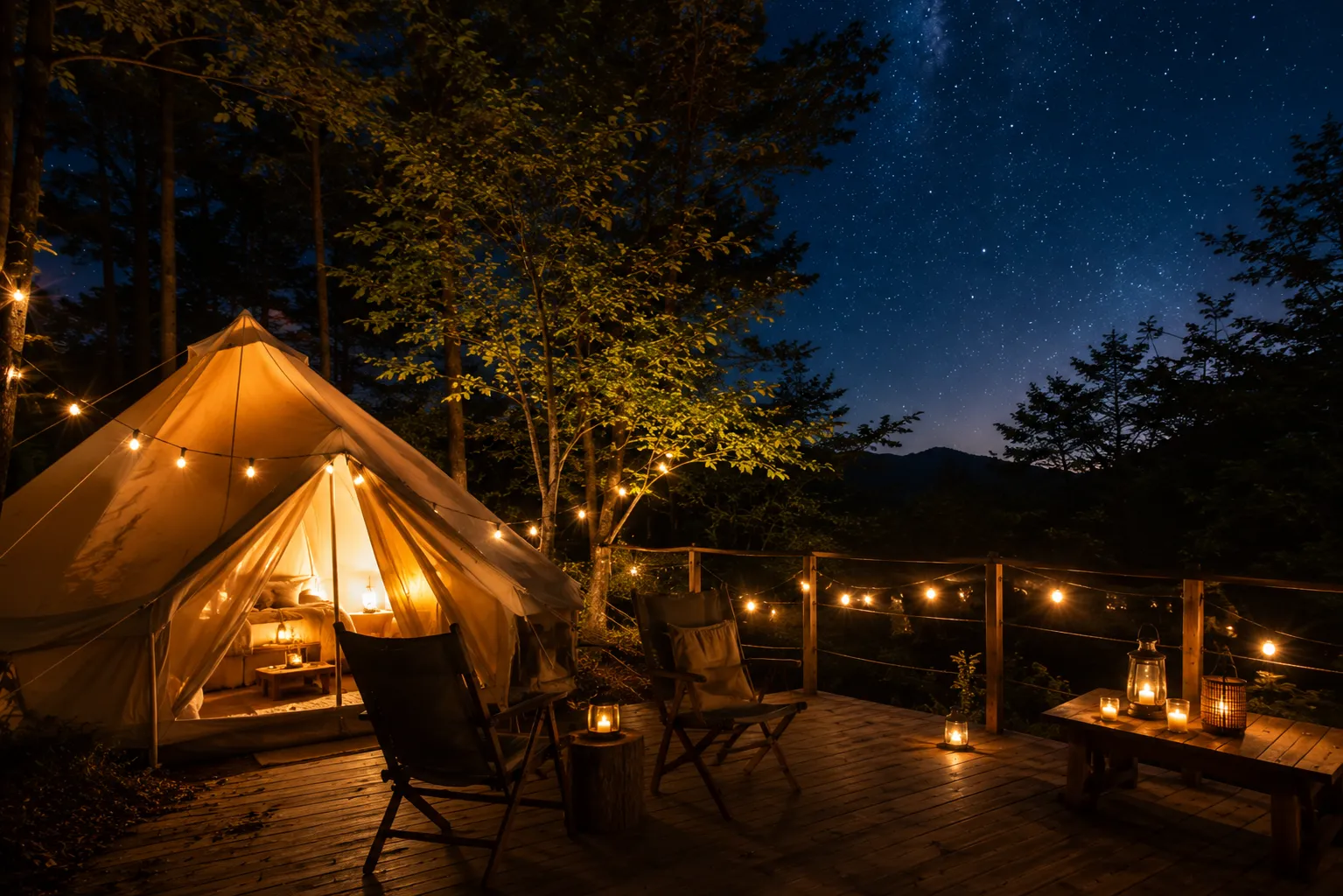
| Safari / bell tent | Canvas tent on a raised deck, furnished | Classic glamping feel, good value |
| Trailer / Airstream | Fitted-out caravan, solid walls | Winter, bad weather, light sleepers |
| Cabin / villa | Small wooden building, often with its own bath | Families, longer stays, privacy |
| Treehouse / unusual | Elevated or novelty structures | A one-off experience |
Canvas tents are the most atmospheric and the least insulated. If you're travelling between December and February, a dome, trailer or cabin is the more comfortable choice.
Chiba is one of the most accessible glamping destinations from Tokyo. The Boso Peninsula offers ocean views, forest settings, and mild weather. It's perfect for a weekend escape without a long drive.
Why Chiba?
If you want a glamping experience with a view of Mount Fuji, Yamanashi is the place. Many resorts here offer dome tents with floor-to-ceiling windows facing the iconic mountain.
Why Yamanashi?
Less crowded than Chiba and often overlooked by tourists, Ibaraki has some excellent glamping resorts surrounded by nature. Prices tend to be lower here too.
Why Ibaraki?
The other side of Mount Fuji, and the one most international visitors never consider. Gotemba gives you Fuji from the south with noticeably fewer foreign travellers around, and it's well placed between Tokyo and Hakone.
| If you want... | Go to |
|---|---|
| The shortest trip from Tokyo | Chiba (northern Boso) |
| Mount Fuji from your bed | Yamanashi (Kawaguchiko, Yamanakako) |
| To travel without a car | Lake Kawaguchiko |
| The lowest price | Ibaraki or inland Chiba, midweek |
| Fewest other tourists | Gotemba or southern Chiba |
| Beaches | Southern Boso Peninsula |
Based in Kyoto or Osaka instead? See glamping near Kyoto and Osaka — Lake Biwa is under an hour from Kyoto Station.
More detail in my guide to glamping near Tokyo and my Mount Fuji glamping guide.
Most Japanese glamping resorts offer:
BBQ is the heart of Japanese glamping. Expect:
One thing worth knowing: at most resorts you cook it yourself. Ingredients are prepped and delivered to your site, the grill is lit for you if you ask, and then the evening is yours. If you'd rather be served a multi-course meal at a set time, that's a ryokan, not glamping.
Depending on the resort and season:
Check-in is typically 15:00, dinner ingredients arrive around 17:00–18:00, and most sites have a quiet hours rule from 22:00. Checkout is usually 10:00 or 11:00. Nothing is scheduled for you between those points — which is the appeal, and also why the evening feels shorter than you'd expect if you arrive late. My hour-by-hour walkthrough covers the whole stay.
Glamping in Japan typically costs ¥15,000–¥50,000 per person per night (roughly $100–$330 USD), including accommodation and BBQ dinner.
Higher-end resorts near Mount Fuji or with ocean views can cost more, but the experience is worth it. For a full breakdown by region, season, and named resort — plus what's actually included in that price — see my complete guide to glamping costs in Japan.
If keeping the cost down is the priority, my cheap glamping guide covers how to pay around a third of the headline rate.
Three things move the price more than the resort does:
You do not need to rent a car to go glamping in Japan, but you do need to choose for it.
The reliable option is Lake Kawaguchiko: a direct highway bus from Shinjuku (about 1 hour 45 minutes), then a resort shuttle or a short walk. Several properties are within walking distance of the station.
The thing to check before booking is the last mile. Listings routinely say "15 minutes from the station" without mentioning that no bus covers it. Most resorts run a shuttle, but almost none let you book it online — you email or phone, usually the day before. My car-free guide explains exactly how to arrange it, and 12Go books the Shinjuku–Kawaguchiko bus in English, which matters because those tickets cannot be bought onboard.
One development worth knowing if you're booking a romantic trip: private barrel saunas have become a standard feature at newer Japanese glamping resorts. Unlike a public bathhouse — which is gender-segregated, so you'd be separated — a private sauna is yours together. For couples this has quietly become one of the better reasons to pick one resort over another. Full guide to sauna glamping here, and a dedicated guide for couples covering areas, costs and timing.
Most visitors aren't coming to Japan for glamping alone — it's one night inside a bigger trip. If you're planning Tokyo, Kyoto and Osaka, see where to fit glamping into a Japan itinerary for exactly which day to use.
The short answer: use it as the night between Tokyo and the Fuji area, or as a decompression night near the end of a city-heavy trip. Don't put it on your first night — jet lag and a self-cooked dinner in the dark is a poor combination.
Yes, with one condition: go for the setting, not the novelty. A night in a dome facing Mount Fuji, or a forest site on the Boso coast, gives you a side of Japan that a city hotel cannot. A generic site an hour from a city with no view is just an expensive tent.
No, at any resort listed on an international booking site. At least one staff member on shift will handle English, and dinner and activities are arranged in advance anyway. Smaller domestic-only resorts are a different matter — book through an English platform and the details get settled in writing before you arrive.
Very. Kids can be loud, run around and eat when they're hungry — none of which works at a traditional inn. Many resorts have fire pits, archery and animal contact, and most have family tents or cabins. See my glamping with kids guide.
Much less than you'd think. Beds, bedding, towels, cooking equipment and food are all provided. Bring layers, closed shoes, insect repellent in summer, and a power bank. My packing guide has the full list.
Yes, and it's underrated. Mount Fuji views are at their clearest between December and February, rates are low, and sites are quiet. Choose a dome, cabin or trailer rather than a canvas tent, and confirm the heating. See my winter glamping guide.
Not per night, but closer than it looks once you account for what's included. A ¥25,000 per-person glamping rate covers dinner and breakfast; a ¥25,000 city hotel room covers neither. Compared like for like, glamping is competitive — and it's the only one of the two that comes with a mountain.
Four to eight weeks for a weekend. Several months for Golden Week (late April to early May), Obon (mid-August) or New Year. A weekday outside those periods is often available at short notice.
Rarely at glamping resorts, unlike at traditional onsen where public baths often restrict them. If a resort has a shared bathhouse, check — but private saunas and in-cabin baths sidestep the issue entirely.
Three things worth reading before your first trip:
For accommodation, Booking.com lists many glamping resorts across Japan with English support. Search by area name — "glamping Kawaguchiko," "glamping Chiba," "glamping Yamanakako" — rather than just "glamping Japan," which is what makes this work.
For activities to build around your stay, GetYourGuide covers Fuji day trips, lake sports and cultural experiences in English, many with pickup from central Tokyo.
If the resort you want is only bookable on a Japanese-language site, see how to book Japanese glamping in English — it covers the phone-number and credit-card blockers, and has an email template that works.
For buses and trains between cities and resort areas, 12Go books in English with international cards.
Glamping in Japan is one of the best ways to experience the country's nature without sacrificing comfort. Whether you're near Tokyo in Chiba, chasing Fuji views in Yamanashi, or exploring the quiet countryside of Ibaraki — there's a glamping experience that fits.
Pick for travel time if you have one night, and for the view if you have two. Book a weekday if your dates allow. Everything else is detail.
If you have questions about planning your trip, feel free to reach out. I'm happy to help.
Book your stay and your activities with English-language support, international payments, and flexible cancellation.