Glamping
What Actually Happens at a Japanese Glamping Resort (Hour by Hour)
This article contains affiliate links. If you book through them, I may earn a small commission at no extra cost to you. Learn more
You've read about the prices, the views, and the seasons. But there's a question underneath all of that which almost no guide answers: what actually happens once you arrive?
Do staff speak English? Does someone cook for you, or do you cook? Are you sharing a bathroom with strangers? What do you do between check-in and dinner?
I work at a glamping resort in Japan, so I see this day unfold from the other side of the front desk. Here's exactly how it goes — hour by hour, including the parts that surprise first-time guests.
3:00 PM — Check-In
Most Japanese glamping resorts check in between 3:00 and 4:00 PM, and this is stricter than you might expect. Arriving at 1:00 PM usually means waiting; arriving after 6:00 PM can be a genuine problem, because dinner service and staffing are built around the standard window.
What happens: You'll be greeted at a reception building or lodge, not at your tent. Expect a short paper form (name, address, sometimes passport number for foreign guests), then a walk or short buggy ride to your site.
On English: At resorts that appear on international booking sites, at least one staff member on shift will usually handle English. It may not be fluent, but it's practised — the same 30 sentences come up every day. Bring patience, use simple phrasing, and a translation app closes any remaining gap. Nobody will be flustered by you.
The orientation: Staff will walk you through the tent, the aircon or heater, the lights, the BBQ setup, and the bathroom situation. This takes five to ten minutes and it matters — this is when to ask your questions, because staff may not come back until dinner.
What surprises people: How complete the tent already is. The bed is made, the towels are folded, the fridge is cold, the fire pit is laid. There is genuinely nothing to set up.
3:30 PM — The Awkward Hour (That Turns Out to Be the Best Part)
Here's the moment most first-timers don't anticipate: you've unpacked, and there's nothing scheduled until dinner.
This feels strange for about fifteen minutes, and then it becomes the point of the entire trip. In a city hotel you'd go out and do something. Here, the doing is optional.
What people actually do:
A practical note: If you want anything from a convenience store — extra drinks, snacks, forgotten items — this is your window. Once dark falls in rural Japan, going out is a hassle. Ask staff how far the nearest store is; often it's a five-minute drive but a forty-minute walk.
5:00 PM — The Bath
If your resort has an onsen (hot spring) or a daiyokujo (large communal bath), before dinner is when Japanese guests use it, and I'd recommend following their lead — it's quieter than after dinner and it sets up the evening perfectly.
How Japanese baths work, briefly: Baths are gender-separated and entered nude — no swimwear. You wash thoroughly at a seated shower station before getting into the communal tub. The tub is for soaking, not cleaning. Tattoos are still restricted at some facilities, though glamping resorts tend to be more relaxed than traditional onsen; ask when you book if this affects you.
If that's not for you: Many glamping resorts have private showers or a private open-air bath attached to each tent, precisely so guests who aren't comfortable with communal bathing don't have to be. Check what your resort offers before you arrive.
6:00 PM — Dinner
This is the centrepiece, and the part that most differs from Western expectations.
You cook — but everything is done for you. Staff bring a tray of prepared ingredients to your site: sliced wagyu beef, seafood, seasonal vegetables, sometimes a rice or soup dish. The charcoal is already lit and at temperature. Your job is to place things on the grill and take them off when they're ready.
It typically takes 90 minutes to two hours, and it's meant to. This is not a meal you rush.
Common questions:
What surprises people: The quality. This is not campground food. Wagyu, fresh seafood, and vegetables from nearby farms are standard at mid-range resorts and up.
8:00 PM — Fire and Stars
After dinner, staff clear the BBQ equipment — you don't wash anything — and the evening opens up.
Most sites have a fire pit with firewood provided. Marshmallows are a common resort-supplied touch. In winter, this is when a wood stove or kerosene heater comes into its own.
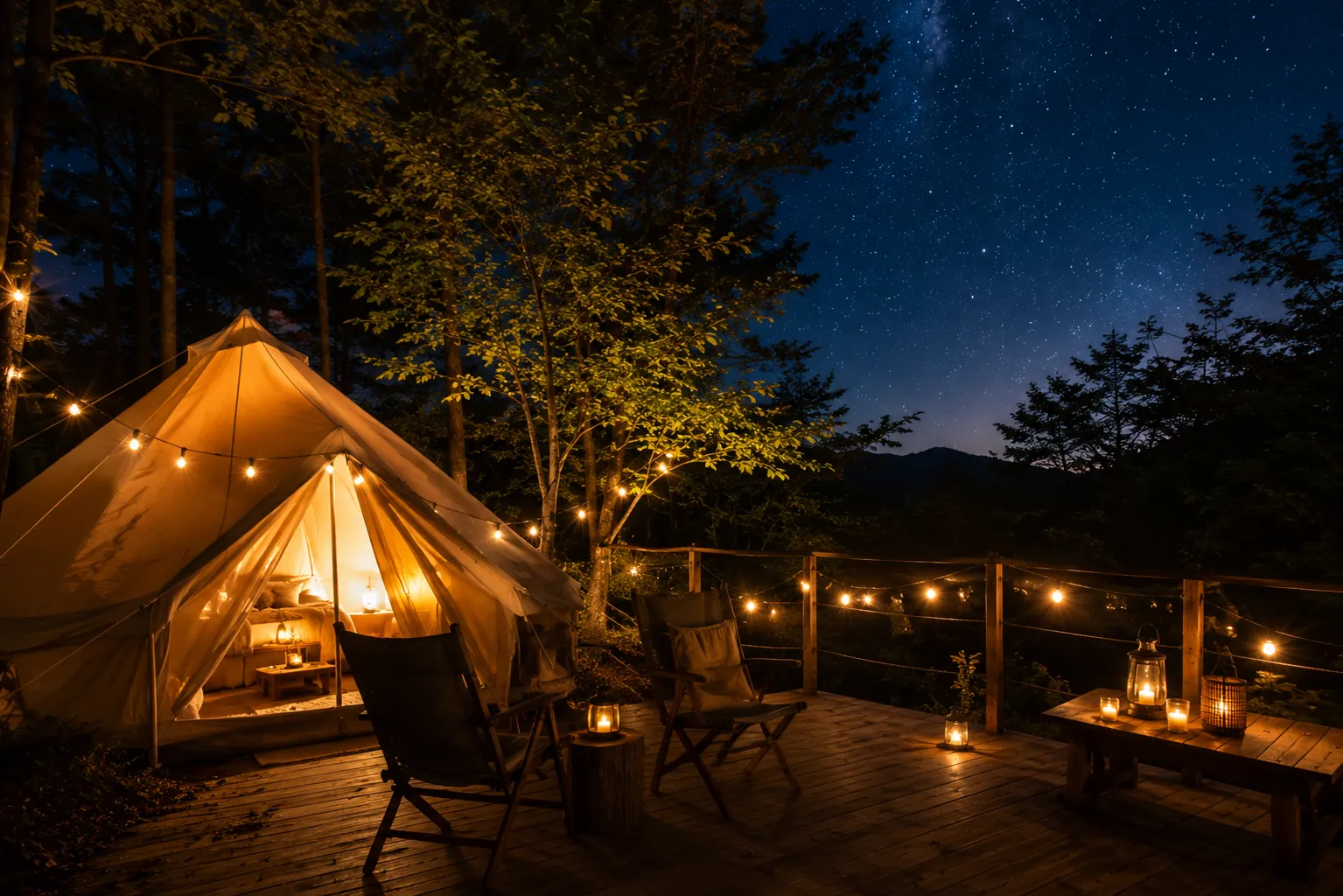
The stars are the underrated part. Rural Japan has genuinely dark skies, and most guests spend longer outside than they planned to. In winter especially — cold, dry air, no haze — the sky is remarkable.
Noise rules matter here. Most Japanese resorts enforce quiet hours from around 10:00 PM, and they enforce them properly. This is a culture that takes shared quiet seriously. It's also why sleeping is so good.
10:00 PM — Sleep
Real bed, real mattress, proper bedding. Heating in winter, air conditioning in summer.
The two things to know:
6:30 AM — Morning
This is the hour nobody books for and everybody remembers.
Mist on the water. Birdsong. If you're near Mount Fuji, this is your best chance at a clear view — the mountain is most often visible early, before daytime cloud builds.
Set an alarm. Seriously. Guests who sleep until eight regularly tell me they wish they hadn't.
8:00 AM — Breakfast
Usually included, and lighter than dinner. Depending on the resort, it may be:
Some resorts serve it at a central restaurant; others deliver it to your site. Ask at check-in so you know where to go.
10:00 AM — Check-Out
Standard check-out is 10:00 or 11:00 AM, and this is where people get caught out.
Two things to arrange the night before:
What you don't have to do: Clean. Strip the bed. Wash dishes. Pack away equipment. You take your own rubbish to the collection point if asked, and that's typically the extent of it.
Six Things First-Timers Consistently Get Wrong
So, Is It Relaxing or Boring?
The honest answer: it's the most relaxing kind of boring there is.
There's no itinerary, no queue, no train to catch. You sit outside, you cook slowly, you watch a fire, you sleep well, and you wake up somewhere beautiful. Guests who arrive wound up from Tokyo leave visibly different people.
If your travel style is "see six things a day," a single glamping night slotted into a busy Japan itinerary is the perfect counterweight — one deliberate pause in the middle of everything else.
Ready to Try It?
For accommodation, Booking.com lists Japanese glamping resorts in English, with each property page showing what's included — meals, facilities, and the nearest station. Search "glamping Kawaguchiko," "glamping Chiba," or a resort name to see live prices for your dates.
For activities to add to your stay, GetYourGuide covers tours across the Fuji area and beyond, with English booking and free cancellation on most bookings.
Not sure where to go yet? Start with my comparison of six real resorts, or see every area ranked by travel time from Tokyo.
Ready to explore Japan's outdoors?
Book your stay and your activities with English-language support, international payments, and flexible cancellation.