Day Trips
This article contains affiliate links. If you book through them, I may earn a small commission at no extra cost to you. Learn more
Almost every guide to glamping in Japan sends you to Mount Fuji. That's fair — the Fuji Five Lakes have the densest concentration of resorts in the country, and the view is the view.
But most people visiting Japan spend half their trip in Kyoto and Osaka. Backtracking to Fuji for one night costs you the better part of two days in transit, and that's assuming you want to see Fuji twice.
You don't have to. Kansai has its own glamping scene, built mostly around Lake Biwa, and the access is genuinely better than the Fuji area's. Some of it is a train ride from Kyoto Station.
I work at a glamping resort in Japan, on the Tokyo side. That's a limit worth naming upfront: the Kansai resorts below are ones I've researched and verified rather than worked at, so I've stuck to what can be confirmed — access, rates, what's included — and flagged what to check yourself.
This is the trade worth thinking about honestly.
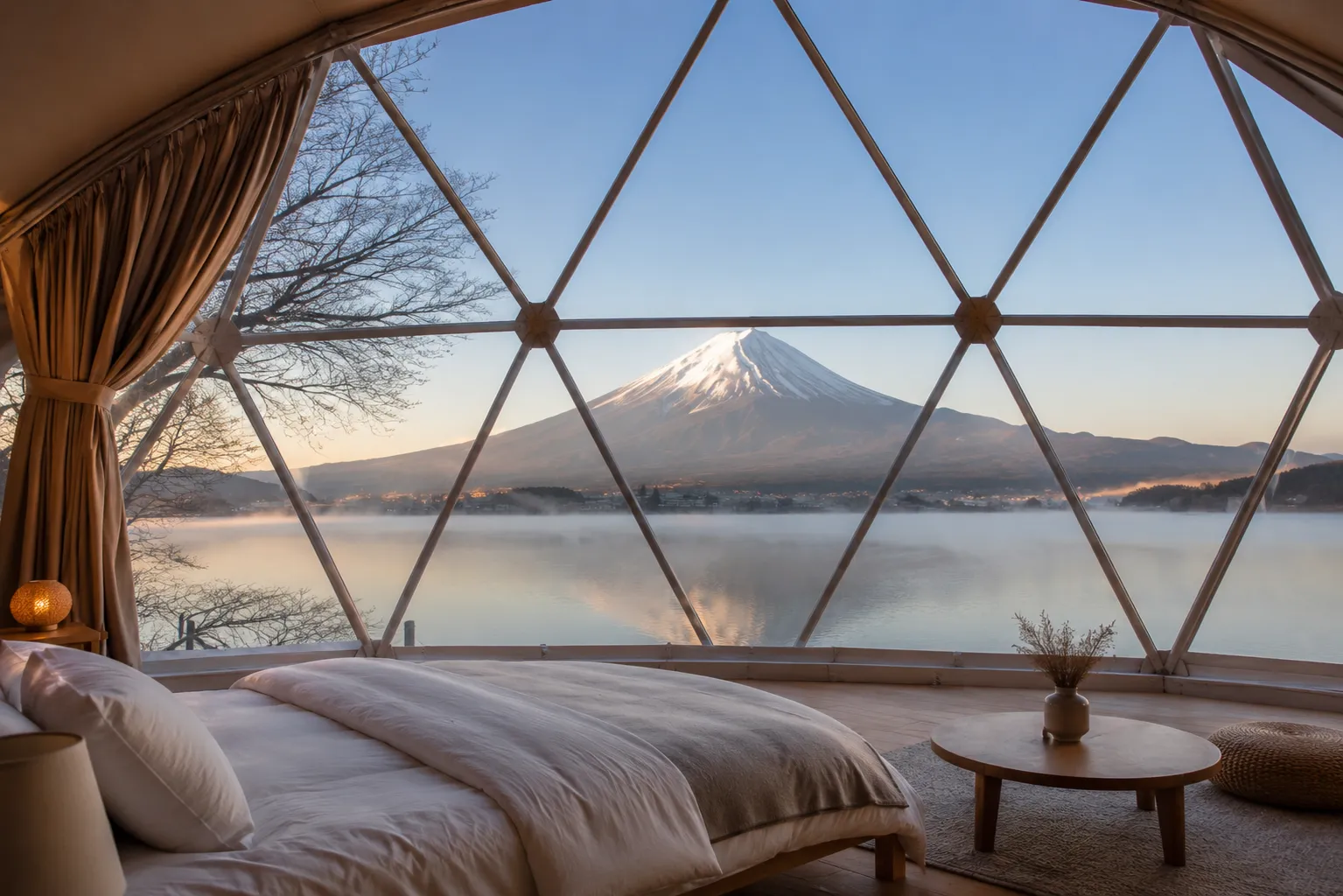
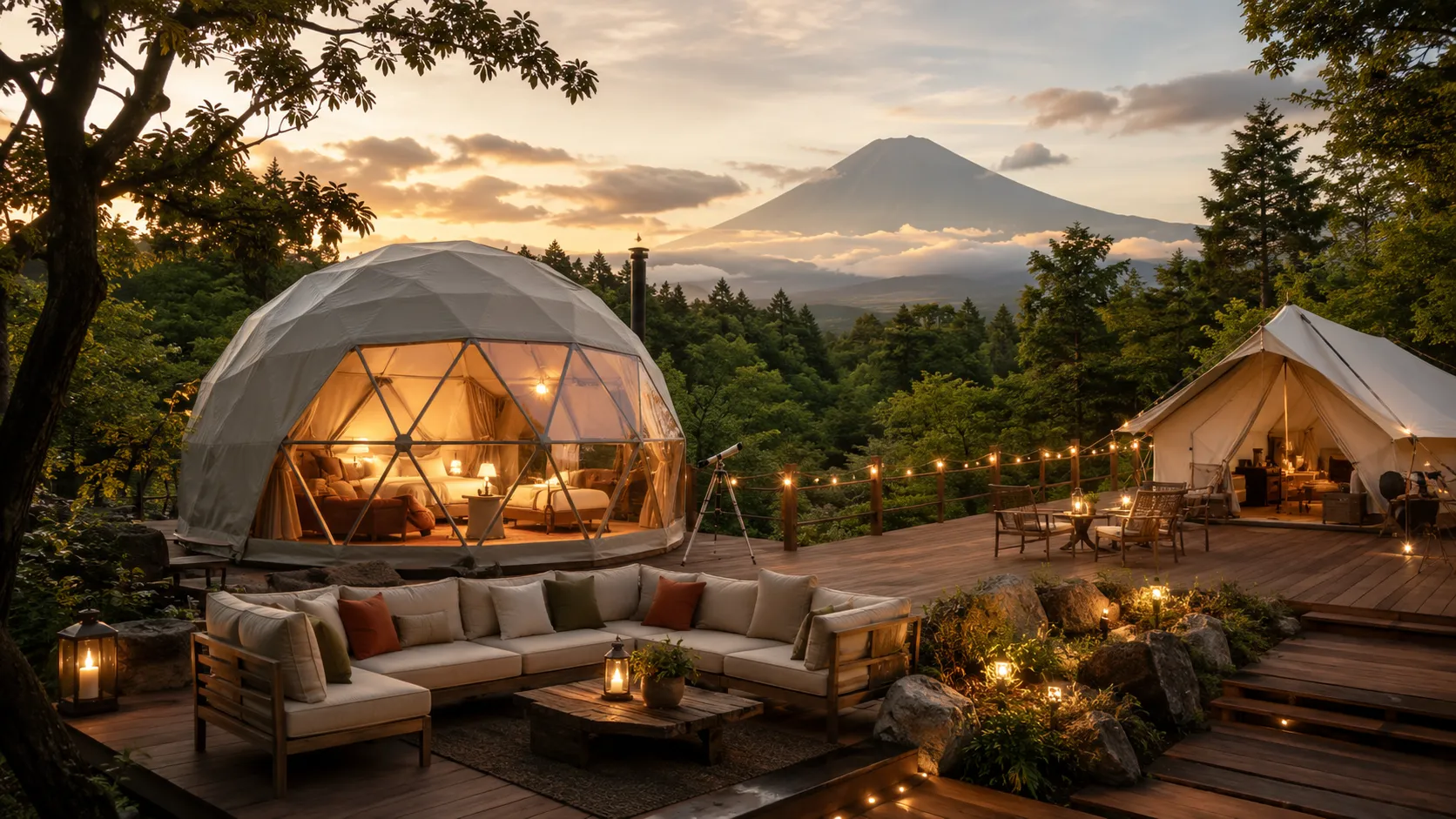
Mount Fuji gives you the photograph. If the dome-with-Fuji-framed-in-the-window shot is the reason you want to go glamping in Japan, no amount of lakeside scenery substitutes for it. Go to Yamanashi — my Mount Fuji glamping guide covers which resorts have the view from the bed.
Lake Biwa gives you the day back. From Kyoto, you are at the lake in well under an hour. From the Fuji Five Lakes, you are about four hours from Kyoto each way. For a traveler on a 7-to-10 day trip, that difference is an entire day of sightseeing.
There's a second, quieter advantage: almost no international visitors. Lake Biwa is a domestic holiday destination. You will be the only foreign guests at most of these resorts, which is either the appeal or the drawback depending on what you're after.
Lake Biwa sits immediately northeast of Kyoto. The glamping is clustered along the western shore, served by the JR Kosei Line, which is what makes the car-free access work.
| From | To | Time |
|---|---|---|
| Kyoto Station | Otsu (southern lake) | ~10 min |
| Kyoto Station | Kitakomatsu | ~34 min |
| Kyoto Station | Omi-Takashima | ~50 min |
| Osaka Station | Otsu | ~40 min |
| Osaka Station | Omi-Takashima | ~90 min (via Kyoto) |
From Osaka you generally change at Kyoto onto the Kosei Line. Nothing here needs a reserved seat or a rail pass calculation — these are ordinary local and rapid services.
Lakeside Terrace Biwako (Takashima) is the one I'd point most people to. It has natural hot spring baths on site, which is unusual for glamping and effectively gets you an onsen experience and a glamping experience in the same night. Accommodation ranges from dome tents to cottages with private pools. It's about a 15-minute walk from JR Omi-Takashima Station — the only resort in this guide you can reach entirely on foot.
Glamp Dome Shiga Takashima is dome tents with private gardens and BBQ, about 5 minutes by car from the same Omi-Takashima Station. Straightforward, and the dome format is the one that photographs well.
Glamping Village Shiga-Imazuhama has a private natural hot spring and sits within walking distance of the Imazuhama beach area. Reached by about 6 minutes by car from JR Omi-Imazu Station.
VIWAKO GLASTAR (Otsu) is on Aoyagi Beach at the southern end of the lake, so it's the closest to Kyoto. Charcoal BBQ with nothing to bring. Note that its tent layouts were reworked in 2024, so check the current configuration rather than older photos.
Lakeside Resort & Cafe AFUMI (Kitakomatsu) is about 34 minutes from Kyoto Station, making it the easiest for a short overnight.
I have not stayed at these personally. Rates, availability and operating seasons change, so treat the above as a shortlist to check rather than a set of recommendations with my name on the quality.
Lake Biwa dominates, but it isn't everything.
Awaji Island (Hyogo) sits between Kobe and Shikoku, reached by bus across the Akashi Kaikyo Bridge. There are seaside glamping sites here, and the island is a genuine destination in its own right — flowers, coastline, and some of the best seafood in the region. A car makes it much better.
The Hyogo hills, inland from Kobe, have dome sites with mountain views. Closer to Osaka than Lake Biwa in distance but generally harder without a car.
Osaka Prefecture itself has a handful of sites in the southern hills. Convenient if you're based in Osaka and want the shortest possible trip, though the scenery doesn't compete with the lake.
If you're choosing blind and travelling by train, go to Lake Biwa.
The honest answer is that one night is right for almost everyone.
The slot that works: after your Kyoto days, before you move on. Kyoto is intense — temples, crowds, a lot of walking on hard surfaces. A night at the lake resets you, and you come back into the trip rather than limping to the end of it.
A shape that works well:
You lose roughly half a day of sightseeing. Compare that with the two days a Fuji detour costs from the same position.
Luggage: don't drag suitcases to a lakeside resort. Leave them at your Kyoto hotel if you're returning, or forward them ahead with takkyubin for about ¥2,000–¥3,000 per bag. My itinerary guide covers the logistics of fitting a glamping night into a city-based trip.
Kansai glamping runs on the same model as everywhere else in Japan: furnished tents or domes with real beds, heating and cooling, a BBQ dinner included, breakfast the next morning. My hour-by-hour walkthrough applies here unchanged.
Three things are specific to this region.
Hot springs are more common. Several Lake Biwa resorts have natural onsen on site. Around Fuji this is rare; here it's a genuine differentiator, and it's the main reason I'd steer a first-timer to Lakeside Terrace over a plain dome site.
Expect less English. These resorts serve a domestic market. The high-end Fuji resorts are used to international guests in a way Lake Biwa ones are not. This is manageable — most have English websites, and booking in writing works — but read how to book Japanese glamping in English before you start, particularly the email template.
The weather is milder than the Fuji area. Lake Biwa is near sea level; the Fuji Five Lakes sit at 900–1,000m. Winter here is cold but not severe, which widens your options in December and January. Summer, conversely, is hot and humid in a way the Fuji highlands are not.
Expect ¥15,000–¥35,000 per person per night including BBQ dinner and breakfast — generally a little below the Fuji area, where the view carries a premium.
Remember that Japanese accommodation is priced per person, not per room. A ¥25,000 listing is ¥50,000 for two people. This is the most common booking surprise for visitors, and it applies here exactly as elsewhere. My cost guide breaks down what's included and what tends to be charged on the day.
Weekdays are meaningfully cheaper and quieter than weekends, which matters more than the choice of resort.
Yes — around Lake Biwa in Shiga, immediately northeast of the city. The southern end of the lake is about 10 minutes from Kyoto Station by train, and the main glamping cluster on the western shore is 35–60 minutes out.
Yes, though fewer options than Kyoto has. Lake Biwa is 60–90 minutes away, usually via Kyoto. Closer alternatives are Awaji Island and the southern Osaka hills, both better with a car.
Yes, better than you can around Mount Fuji. The JR Kosei Line runs along the western shore of Lake Biwa, and several resorts are a short walk or a 5-minute taxi from a station. Lakeside Terrace Biwako is about a 15-minute walk from Omi-Takashima Station.
Fuji if the mountain view is the point of the trip. Lake Biwa if you're already in Kansai and don't want to lose two days to the detour. The experience itself — dome, BBQ, fire, quiet — is much the same; the view and the travel time are what differ.
Roughly ¥15,000–¥35,000 per person per night with dinner and breakfast included — somewhat less than Fuji-view resorts. Prices are per person, so double it for a couple.
Several do, which is unusual for glamping in Japan. Lakeside Terrace Biwako and Glamping Village Shiga-Imazuhama both have natural hot springs on site. It's the strongest reason to choose this region over the Fuji area if an onsen is on your list anyway.
Less reliably than at the big Fuji resorts, since these mainly serve domestic guests. Most have English websites, and booking in writing works well. Settle dietary needs and shuttle arrangements by email in advance rather than expecting to sort them out on arrival.
For almost everyone, yes. The point is one evening outdoors as a break from city days — arrive mid-afternoon, dinner at the fire, breakfast, leave by late morning. Two nights makes sense only if you want a full day of lake activities.
Spring and autumn for the weather. Winter is quiet and cheaper, and milder here than in the Fuji highlands. Summer is hot and humid at lake level — manageable, but the Fuji area is the better choice for a summer escape. See my season guide.
For accommodation, Booking.com is the straightforward route — search "glamping Shiga," "glamping Lake Biwa," "glamping Awaji" or "glamping Takashima" rather than "glamping Kyoto," since the resorts are in neighbouring prefectures and area-name searches are what work in Japan.
Several of these resorts also have their own English websites and take direct bookings. If a resort you want isn't listed internationally, my guide to booking in English covers the workarounds.
For trains, 12Go handles Japanese rail in English if you want tickets sorted before you arrive. For the local Kosei Line legs you don't need anything booked — just tap through with an IC card.
For activities around Kyoto and Osaka to build the rest of the trip around, GetYourGuide covers the region in English.
If you're building a Japan trip around Tokyo and Kyoto and you want one night outdoors, the reflex is to detour to Mount Fuji. For a lot of travelers that detour isn't worth two days.
Lake Biwa is 35–60 minutes from Kyoto Station, has resorts you can walk to from the train, and several with hot springs attached. You trade the Fuji view for a day of your holiday and a quieter resort.
Check the resort's own English site alongside the booking platforms, settle the details by email, and go midweek if your dates allow.
Book your stay and your activities with English-language support, international payments, and flexible cancellation.