Glamping
Mount Fuji Panorama Glamping: What It Is and How It Compares
This article contains affiliate links. If you book through them, I may earn a small commission at no extra cost to you. Learn more
Of all the Fuji-view glamping properties people search for by name, this is the one that comes up most — and for a specific reason that isn't obvious until you look at a map.
It's a six-minute walk from Kawaguchiko Station.
That single fact changes what this place is for. Almost every dome resort with a Mount Fuji view sits somewhere you need a car or a booked shuttle to reach. This one you can walk to, with a suitcase, straight off the highway bus from Shinjuku.
I work at a glamping resort in Japan, so here's an honest look at what that gets you — and what it doesn't.
The Basics
| Location | Funatsu, Fujikawaguchiko (Yamanashi) |
|---|---|
| Access | ~6 min walk from Kawaguchiko Station |
| Accommodation | One "Imperial Panorama" dome tent, plus trailer houses |
| The dome | 7m diameter, two king beds, sleeps up to 4 |
| Inside | Air conditioning, fridge, microwave, projector, speakers |
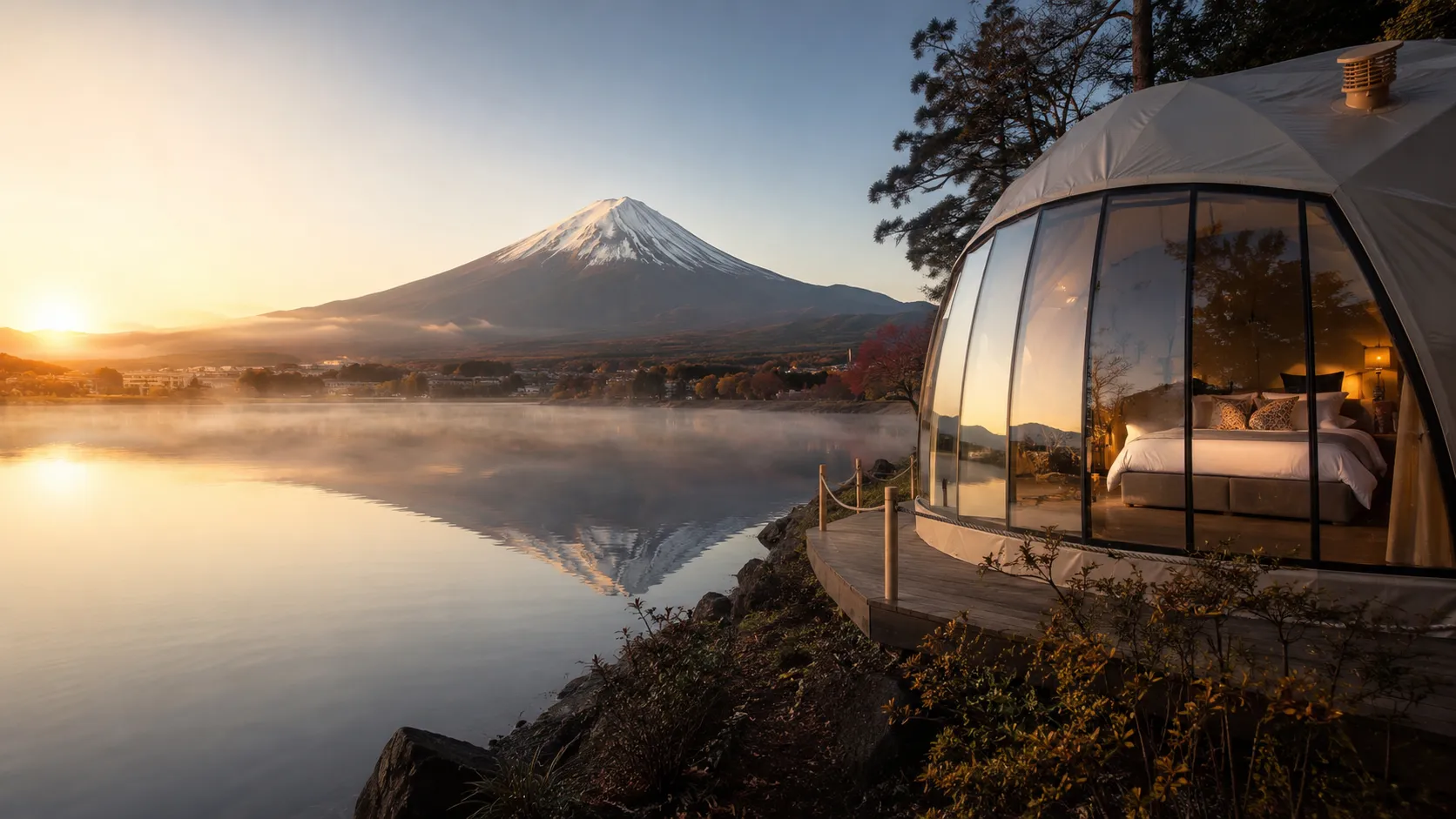
| View | 180° panorama of Mount Fuji from a hillside position |
| Typical rate | Roughly ¥12,000–¥24,000+ for two, varying by season |
Rates and availability move a lot with the season, so treat these as orientation rather than a quote.
What Makes It Different
The view is the entire product, and it's positioned properly. The site sits on a hill in the Funatsu Magome district, which is a known viewpoint locally. You're not looking at Fuji through a gap in the trees — the dome faces an open panorama.
You can arrive without a car. This matters more than most guides admit. As I explain in my car-free glamping guide, the "last mile" is what defeats most people travelling Japan without driving: you reach a station and then need a shuttle you didn't book or a taxi that isn't there. Here, you walk.
The dome is unusually well equipped. A projector and speakers inside a glamping dome is not standard. It changes the evening — a film under a dome ceiling on a rainy night is a genuinely good fallback when the mountain is hidden.
It's small. One dome, a handful of trailer houses. That means quiet, and it means booking early.
The Honest Caveats
Mount Fuji is not guaranteed. No property can promise this. Cloud hides the mountain often, especially summer afternoons. Your best odds are early morning, and the clearest months by a wide margin are December to February — dry winter air, snow-capped peak. My season-by-season guide has the full breakdown.
Book two to three months ahead. With one dome and high demand, this is not a place you decide on a Tuesday for that Saturday.
Check what "glamping" means for your room type. The dome and the trailer houses are different experiences at different price points. Read the room description carefully rather than assuming the dome photos apply to everything.
Being near the station cuts both ways. You're in town rather than deep in nature. That's a feature if you want cafes, an onsen, and the sightseeing bus within reach — and a drawback if what you pictured was forest silence.
How It Compares to the Alternatives
If you're searching for this property specifically, these are the ones worth putting beside it:
| Best for | Trade-off vs Panorama | |
|---|---|---|
| Mount Fuji Panorama Glamping | Car-free travellers, panoramic view, small scale | In town, not deep nature; books out early |
| Dot Glamping Fujiyama | The classic dome-with-Fuji morning | Needs a shuttle or car; quieter Oishi side |
| HOSHINOYA Fuji | The most polished experience in Japan | Two to three times the price |
| Private Villa Glamping Fuji Yamanakako | Private onsen, total privacy | Premium pricing, colder lake, needs transport |
| PICA Fujiyama | Activities and Fuji climbing | Lively rather than intimate |
I compare all of these in detail — including what a night at each is actually like — in my honest comparison of six Japanese glamping resorts.
My short recommendation: if you're travelling without a car and the view is the point, this property is the most practical choice near Kawaguchiko. If you have transport and want the quieter, more scenic setting, look at the Oishi-side domes instead.
Practical Notes Before You Book
Getting there: The direct highway bus from Shinjuku to Kawaguchiko takes about 1 hour 45 minutes and costs roughly ¥2,000–2,500. Walk from the station. That's the whole journey — no transfers, no shuttle to arrange.
When to go: Winter for the clearest views and lowest prices; late October to mid-November for foliage plus good visibility. Avoid Golden Week and mid-August unless you've booked months ahead.
Stay two nights if the view matters. One night gives you one morning. Two doubles your chance of a clear Fuji, and it's the single best piece of advice I give guests.
What to bring: Less than you think — everything is provided. But insect repellent from April to October, and one more warm layer than you expect. My packing guide covers the specifics.
Where to Book
Booking.com lists Fuji-area glamping properties in English with live pricing, flexible cancellation on most listings, and the nearest station shown — search the property name directly, or "glamping Kawaguchiko" to compare it against everything else available on your dates.
For activities around your stay — Fuji day trips, lake cruises, Oshino Hakkai, or the Chureito Pagoda — GetYourGuide covers the Fuji region with English booking and free cancellation on most bookings.
The Bottom Line
This property solves a real problem: it puts a panoramic Mount Fuji view within walking distance of a station, in a country where nearly every equivalent view requires a car.
Book two nights, go in winter if you can, and set an alarm for sunrise. If the mountain is out, you'll understand immediately why people search for this place by name.
Ready to explore Japan's outdoors?
Book your stay and your activities with English-language support, international payments, and flexible cancellation.